
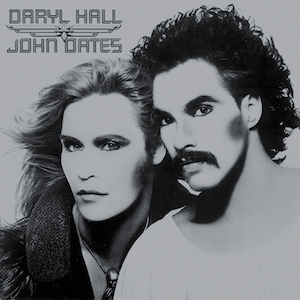
At 14 I was an avid reader of Melody Maker, a weekly source of much inspiration and inky fingertips. In 1975 I was constantly confronted with the image accompanying this piece, marking relentless promotion for an album which seemed not to have a title, except for “Daryl Hall and John Oates.” I had no idea who they were?
And who was that blond on the album cover?
It’s worth noting that I was deep into my Heavy Rock phase; my life had recently been changed by the “meisterwerk” that was “Physical Graffiti” and hence I was engulfed a “proto-mancrush” with another blond, vocal pyrotechnician. I was no stranger to these feelings as the “veteran” of unrequited passions for Dave Davies of the Kinks, Marc Bolan and David Bowie to name just three. Forty years later I am still prone, but not ready to totally embrace the dramatic “lifestyle change.”
When I approached “The Silver Album” I must admit my hopes were crushed a little on discovering the immaculately conceived and performed “white soul”, Rhythm and Blues music contained within.
Where the hell were the blazing guitar solos?
Eventually, the subtlety and delicacy of the mellifluous “Sara Smile” seduced my ears, wore me down and my brain finally accepted that there were never going to be any face melting guitars as I explored this (for me) new genre and new act.
And the hits kept on coming. The peerlessly plaintive “She’s Gone”, “Rich Girl”, “Kiss on My List”, “You Make My Dreams”, “Private Eyes”, “Maneater”, “One on One”, “Out of Touch”. Most artists would kill for such a run of amazing records.
I was overwhelmed by the sheer genius of the song writing, the production values and dammit just the sheer joy of great melodies that made you want to dance.
It’s worth noting that by now The Clash and The Ramones had been added to my personal canon of great bands and yet, here I was, a 24-year-old Daryl Hall and John Oates fan!
I can only explain it in these terms: A great single is, and has always been an artform; just as much as a perfectly conceived album. Maybe more so?
But I’ve missed the most important song.
From the start, I couldn’t understand how a white man could possibly have given us a bassline so immaculately funky, from somewhere in his Korg keyboard and his head. It was a perfect slice of disco-soul; the first hit by a white artist to use such heavy programming of electronically synthesised sounds. A lyric so timely and “street” it could conceivably have come from Prince and it was indubitably a killer dance track.
I hated dance music, but I was playing “I Can’t Go For That” endlessly and falling for Daryl Hall. I’m so sorry Barbara!
The production had space and delicacy, every quicksilver flourish had its place and then there were the lush, layered, overdubbed harmonies and that lead vocal! Always compelling, insistent and demanding with a devastating command of pitch, phrasing and effortless passaggio from tenor to falsetto.
Daryl Hall’s credits on this song include Keyboards, Synthesizers, Roland Cr-78 drum machine, lead vocals, backing vocals, co-production and one third of the lyric writing credits with John Oates and Sara Allen. Yes, she of “Sara Smile” fame
Then I saw them on TV. Or rather I watched him.
He played guitar, he played keyboards, he joked with the other musicians and the audience and boy did he sing. There were the hits obviously, but on “You’ve Lost That Loving Feeling” and “Every Time You Go Away” (yes Daryl wrote that as well!) he was breath-taking. Pushing his voice to heights that demonstrated that studio work restricted rather than enhanced your appreciation of his amazing “instrument.” Daryl was tall, blond, had amazing cheek bones and an ability to push his voice to a soulful, counter tenor breaking point that put me in mind of Marvin Gaye. He was that good!
But at the back of my mind, as I sat rapt on my couch I thought: “Daryl you might pay for this later.”
Take the time machine forward 30 years or so to last Saturday night. Pressure. 42 years after seeing that silver album cover I was going to be in the same room as my hero. Pressure. I was taking my best friend to the gig for his birthday present. More pressure. And Daryl Hall is also 42 years older. Too much pressure?
First let me say that Daryl Hall and John Oates were occasionally brilliant, giving shimmering glimpses of the hits and time served performance. They started with songs that made you say: “I didn’t expect this so early” it’s the confidence that comes with THAT back catalogue. And the hits kept coming.
Let’s start with the things that Daryl and John couldn’t help. The O2 is a cavernous space and not easy to turn into a dance club. It was a “seated event” and that always robs some of the joy of live music. Then there is the age of the audience, including me. During the first number we stood up to dance. But after five minutes or so much of the audience seemed glad they had a seat. Reluctantly and feeling increasingly self-conscious, I sat down.
Then the questions started to form: Why was the sound so muddy? The lights and the backdrop were expensively compelling, so how come I didn’t hear a cymbal or a snare drum in nearly 90 minutes? Unusually, the audio quality for support act Chris Isaak was impeccable.
There were too many guitar solos (yes, it’s still me writing) and a saxophone player who has been with them for 32 years and seems to think he is the star. He’s not!
Daryl seemed in turns; distracted, annoyed with his monitors, confused and in addressing the audience his charisma deserted him. Even I was struggling.
The birthday boy wondered aloud: “Is he pissed?” And then there was “I Can’t Go for That.”
In contrast to the spacious, fleet footed elegance of the recorded track, this guaranteed dance floor filler was reduced to a confusing “lounge jazz” mess! Had they decided to experiment with the arrangement on the night? Maybe they couldn’t hear the rhythm section either? Where was the insistent, addictive bassline? And where was Daryl’s voice?
I can’t delay it any longer, let’s reckon with the inevitable conclusion. I would estimate that Daryl has lost 40-50% of his vocal range. Worse than that, he has lost the part where all the magic happened. The part that made your hair stand up. The tenor is still there because he sang almost all the first verses perfectly, but then the cracks started to appear. The falsetto is ragged but still there. It’s the soulful counter-tenor soar into alto that is no more.
The pyrotechnics don’t work any longer. What we were witnessing was a great artist struggling and frustrated that his gift had given up giving!
It is possible that Daryl Hall was ill, I don’t think he was pissed. But surely, if they don’t want to retire they could employ some killer backing singers? Re-arrange the songs to allow him to sing in a comfortable register? Sack the sound guy?
Or better still, don’t charge £85 for a performance of this standard, lasting only 80 minutes!
Live music is often a transcendent joy but on this occasion for me, there was a lot of sadness and “that loving feeling” was “gone, gone, gone.” Woe is me.
There is no joy in seeing your heroes grow old and crumble, but at least we have the majestic array of killer hits to provide comfort and remind us of better times past.
As I wrangle my sadness and disappointment, I will give the last words to the ever logical birthday boy Tony Moyle:
“At least we’ve checked them off the list!”
 mono magazine